

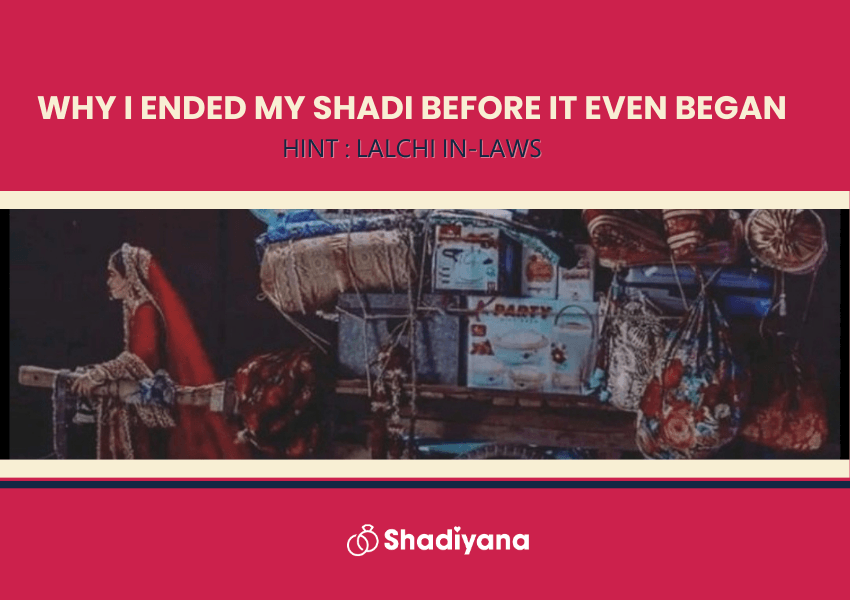
Bas jee, ham tou yeh jahez waghera nahi lete, jo dena hai apne apni beti ko dena hai.
That was literally the first thing my would-have-been mother-in-law said to me. At the time, I smiled. In my head, I thought, wah, such progressive people, not into this whole dowry culture. Now, when I look back, I think, that was the first red flag.
I met this guy, my ex fiance 5 years ago and we had been in a long committed relationship for good 4 years. We met in our university, in Islamabad. Same campus, same group of friends, same annoying teacher for Statistics 101. It started with random group study sessions that slowly became just the two of us. Four years together, birthdays, assignments, family introductions, all of it. And to be fair, to this guy i only have nice things to say about the guy, he was a good guy. Supportive, respectful, never made me feel small.
But his family? Yeh tou alag hi story hai.
Materialistic, status-conscious, and honestly just exhausting. You know that saying “the fruit doesn’t fall far from the tree”? I learned it the hard way.
Let me break this down for you, I’m the kind of person who believes you don’t just marry a man, you marry his entire family. Especially in Pakistan, where living separately after marriage isn’t the default. I’ve grown up in a home that’s loud and chaotic and I mean that in the best way. We fight, we laugh, we make up over chai, and we show up for each other. I love all that. I want all that. That’s the kind of family I want my kids to grow up in too, one that’s about connection, not calculation.
But every time I was around his family, I felt like I was in a transaction, not a relationship. Conversations would somehow circle back to money, property, who gave what to whom at which wedding. I ignored it. Because something just made me feel that things will work out.
And then one day, during one of those casual pre-wedding chai dawats, I overheard his khala and ask his mom while we were getting chai through the drawing room:
“Toh gari ki baat hui hai bachi ke ghar walon se?”
It wasn’t said as a joke. It wasn’t even whispered. It was just… casual. I froze. In my head, I kept telling myself, no no, you’re overreacting, maybe they mean something else. And it’s his khala not his own mom right? But the worst part? No one laughed. No one said anything. Not even my fiancé. He later told me, “Yaar, yeh tou normal hai, families demand kar lete hain kabhi kabhi.”
Normal? Demanding a car? Normal?
In my world, “normal” is bringing mithai for your new daughter-in-law. Not expecting her parents to finance your next set of wheels. I’ve seen my father work day and night to try to make me an independent woman who can take responsibility and to expect him to finance a grown man’s life to cut the deal of my marriage did NOT sit well with me.
That moment hit me like a ton of bricks. If this was “normal” for them before the wedding, what would “normal” look like after? And it wasn’t about the car, it was about values. I guess what hurts me the most is that I couldn't bat an eye at that for 5 long years. It was about realizing that for them, these material expectations weren’t a problem; they were a way of life. And I didn’t want to raise a family in that kind of environment.
So I ended it. Four years of love, gone, not because of a car, but because of what it represented.
I’m not going to lie, I was sad,I am sad but I don't regret what I did for a second. I’m even writing this to a wedding planning page because I think that for us as women in wedding planning, we get so caught up in colors, venues, and menus that we sometimes ignore the most important part, the people. It’s not just about whether you and your partner are a match. It’s about whether your family can build the kind of life you actually want.
And if the first thing someone says to you is, “We don’t take dowry… but,” remember, the “but” is where all the trouble starts.